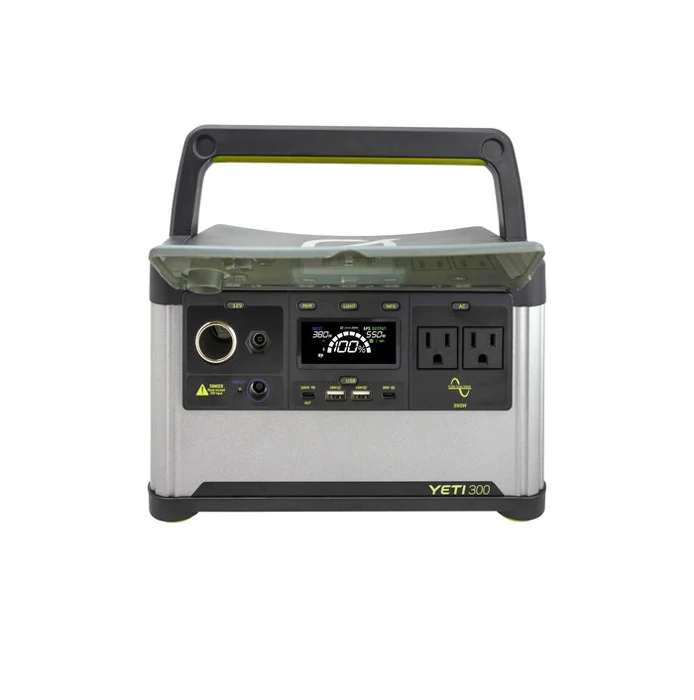
Not every trip needs a large battery station taking up the vehicle floor. The Goal Zero Yeti 300 offers a smaller 297Wh reserve, with a listed size and weight that may be easier to fit among ordinary supplies.
Small Capacity Should Match a Small Plan
I'd compare it around electronics, lighting, and other suitable lower-demand equipment. The exact output specifications still decide what can be connected. A compact station isn't automatically a suitable source for a heater or high-wattage kitchen appliance.
- Capacity: Approximately 297Wh.
- Chemistry: LiFePO4.
- Weight: 13.7 pounds.
- Operation: Pass-through charging is listed.
Charging Speed Can Be Chosen
The manufacturer’s published specification lists a 420W fast AC mode and a 140W default mode. I'd choose around the available supply and refill need, following the station's instructions. A lower input can be appropriate when sharing a limited power source with other equipment.
Solar input has its own voltage and current limits. Those limits should be checked before pairing a panel, even if an adapter makes the connectors physically fit.
Think About How Often the Reserve Is Refilled
For a short outing, a charged small station may be enough. For repeated evenings, the ability to replenish it becomes part of the purchase. I'd estimate actual energy use with room for conversion losses, rather than assign a runtime from capacity alone.
The temperature specification distinguishes charging from discharging. That matters if the station has been stored in a cold vehicle; follow the appropriate limits before starting a refill.
This is a published-specification review. I'd shortlist Yeti 300 for someone who needs station-style connections with a modest reserve. If a few USB devices are the whole load list, a power bank could be simpler; if large appliance energy is needed, a bigger station class makes more sense.