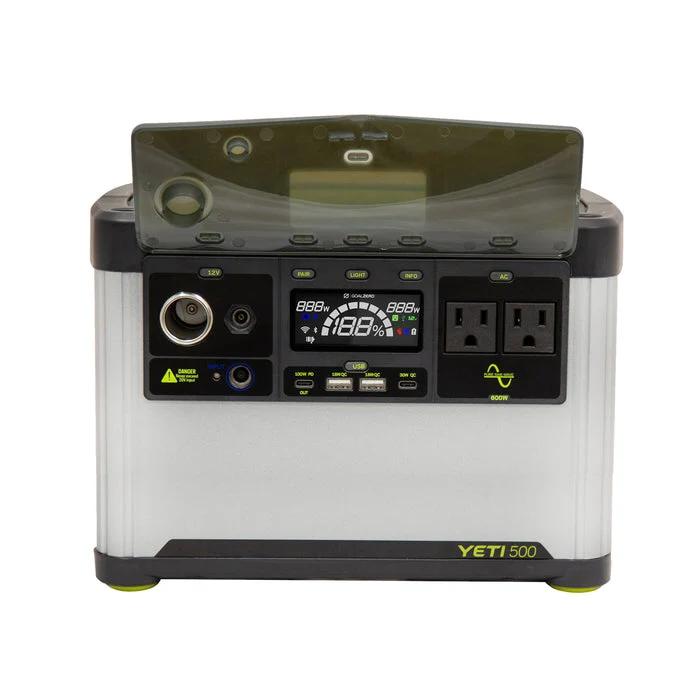
Half a kilowatt-hour can cover useful small-device work without buying the biggest station in the lineup. The Goal Zero Yeti 500 provides a listed 499.2Wh reserve in a 16.1-pound unit.
Start With the Jobs That Need a Station
I'd compare it for a camp or household setup where a power bank no longer covers the required connections. The exact AC and DC output limits still need to match each device. A watt-hour capacity isn't a promise that a high-wattage appliance can operate.
- Capacity: 499.2Wh.
- Cell chemistry: LiFePO4.
- Weight: 16.1 pounds.
- Charging behavior: Pass-through use is listed.
Fast and Default Charging Differ
The manufacturer’s published specification lists 500W fast AC input and 240W as the default lower-speed input. That gives a useful choice when considering the available supply and how quickly the station needs refilling. I'd follow the input instructions rather than assume every extension or outlet arrangement is suitable for fast charging.
The low-voltage input also has a specified voltage range and current limit. A solar panel must meet those electrical requirements, not simply share a connector shape.
Temperature Limits Deserve a Look
Goal Zero separates permitted charging and discharging temperatures. For a station stored in a cold vehicle, that difference is relevant before plugging it into a charger. Follow the actual ranges for the exact unit and allow appropriate conditions before charging.
The 16.1-pound weight can be manageable for a short carry, though it is a meaningful addition to other gear. I'd choose its storage and travel position before purchase.
I haven't tested the Yeti 500. I'd compare it when roughly this reserve fits the device list and a larger station would mostly add weight. For repeated high-energy tasks, step back and assess replenishment and capacity rather than expecting the small size to cover every load.